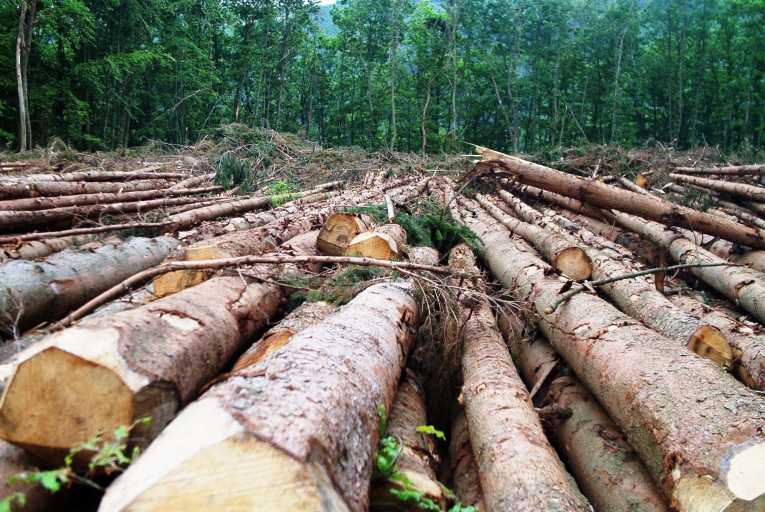
Ghana needs Practical solutions to stop deforestation

Deforestation.01PRESS RELEASE

The Ministry of Lands and Natural Resources has launched the revised forest and wildlife policy at Capital View in Koforidua. The first regional launch involved the following regions, namely; Volta, Eastern and Central Region.

The revised policy approved in 2012 has institutional reforms such as an enhanced active participation of communities and landowners in resource management; promotion of small and medium forest and wildlife enterprises as a means of job creation for the rural/urban poor, an increased biodiversity conservation, promotion of sustainable management of savanna woodland and ecotourism development.

It also includes an increased government commitment to degraded landscape restoration through a massive forest plantation development schemes, improved research and application of modern and scientific technology in resources management, development of climate change adaptation with mitigation measures as well as secured sustainable financing for the forest and wildlife sector.

In a keynote address, the Deputy Minister for Lands and Natural Resources, Hon. Barbara Serwaa Asamoah expressed gratitude to the various stakeholders such as the National and Regional House of Chiefs, Civil Society Groups, Media Impact Organizations among others for their significant contributions and criticisms to the new policy.

She noted that the revised policy had a focus on the management of land and wildlife resources and outlined some interventions from the ministry like the wood tracking system in the domestic export of lumber, introduction of new wood procurement policy and the importation of lumber from other countries as a complimentary effort in the implementation of the forest and wildlife policy.

In a statement, Madam Mavis Ama Frempong, the Deputy Eastern Regional Minister said forest and wildlife resources had been the major contributors to Ghana’s economic development, formal/ informal employment alongside livelihoods and export earnings.

She stated further that most of government policies had experienced challenges in their implementation because there were inadequate consultations with stakeholders. She therefore urged stakeholders to see to the successful achievement of the revised forest and wildlife policy to reverse the degradation of the environment.

On his part, the Technical Director of Forestry at the Ministry of Lands and Natural Resources, Mr. Musah Abu-Juam remarked that the purpose of the launch was to bring to the doorsteps of the ordinary Ghanaian as well as all stakeholders the document which highlights on the conservation and sustainable development of forest and wildlife resources.

He indicated that copies of the document would be available at libraries and appealed to participants to study the policy and educate others.

Source: ISD (Evelyn Harvey)

Posted in Uncategorized | Leave a comment

Water Workshop at Akropong Akuapem

PRESS RELEASE

WaterAid Ghana and its partners, Akuapem Community Development Programme (ACDEP) in its quest to promote Water, Sanitation, Hygiene and Health (WASH) for the promotion of public health as well as reducing the outbreak of communicable and other water related diseases in Akuapem North Municipality have organized a one day workshop at Akropong-Akuapem.

In his welcome address Mr. Krampah the Director of ACDEP said the NGO group has been liaising with other stakeholders such as the Health Directorate, Environmental Health Department, Water and Sanitation to help solve sanitation related issues in the municipality.

He also mentioned that his group had provided a number of boreholes to some communities in the area and had succeeded in inculcating the habit of washing hands frequently after using the toilet, arriving home from town or work or from the funeral grounds in some of the communities within the municipality.

He spoke with pride as he mentioned that in Konko village for in instance, the community had designed the hanging water bottle device to be washing their hands in every household. He called on the Municipal Assembly to commit a fraction of its funds in combating filth and in the area of providing good drinking water to the people.

Dr. S. Anie a Medical Practitioner at the Korle-bu Teaching Hospital and a resource person said in Ghana, about 10,000 infants die by the age of 5 years each year from diarrheoa due to poor sanitation and hygiene. Also in Ghana, 6 out of the top 10 diseases such as Malaria, Skin diseases and ulcers, diarrhoeal diseases, acute eye infections, intestine worms and anaemia were WASH-related.

She also explained that Neglected Tropical Diseases such as trachoma, schistosomiasis and other infections affects over 1 billion people in the world and are linked to sanitation as they were transmitted by faecal contamination and poor hygiene and contaminated water.

Dr. Anie called on all stakeholders to pitch their forces together in order to propagate the message of WASH-Health in homes, schools, churches and the communities at large. She called on the Municipal Assembly to Support WaterAid Ghana and ACDEP by committing at least 5 per cent of its funds to WASH-Health programme. “It is about time we do away with superstitious beliefs and report the least reaction in our bodies to any health facility for quick assistance before it goes out of hand,” She said.

Source: ISD (Samuel Y. Kumah)


Posted in Uncategorized | Leave a comment

EPA should celebrate “Achievements” and not “Existence”

The state of Ghana’s environment  poses great health threat to all. From pollution of water bodies along the Densu river to defaecating into the korle lagoon. These are issues that need to be addressed immediately instead of celebrations whilst still solving greater parts of these problems. What matters of environmental concerns curtails in your neigbourhood?

Leave your comments after reading what EPA thinks of his achievements.

The task of environmental protection in Ghana has not been easy, but for the past four decades, the Environmental Protection Agency (EPA) has made tremendous strides in the discharge of that responsibility.

And on the occasion of its 40th anniversary in February, it is worth celebrating, the modest achievements of the EPA even in the face of human resource, financial and logistical constraints.

But beyond the celebration of EPA @ 40, there is a job to be done for future celebrations; it may seem daunting, but with a collective responsibility and greater consciousness by everyone about the need to protect the environment, that task will be surmounted.

The history

Prior to the 1970s, there had been growing concern globally about the dangers human activities posed to the environment.

That concern prompted the United Nations (UN) to organise the Stockholm Conference on Human Environment in June 1972, and according to the leader of Ghana’s delegation to the conference, Mr K. B. Asante, Ghana made a strong impression at that event which was very important, given the decisions taken.

Based on the recommendations of the Stockholm Conference, Ghana established the Environmental Protection Council (EPC) in 1974 with the view of addressing emerging environmental challenges.

Former President J. A. Kufuor, who once had oversight responsibility of the EPC as Deputy Secretary of Local Government and Rural Development, thought the decision to set the agency was very appropriate.

“We need to think ahead, perhaps two to three decades ahead and formulate policies so we are not overtaken by population explosion and its impact on the environment,” he pointed out.

Law establishing the EPC

The EPC was established by the Environmental Protection Council Decree, 1974 (NRCD 239), after the Head of State and Chairman of the National Redemption Council (NRC) had given his assent to the law on January 23, 1974.

But it was not until June 4, 1974 that the council was inaugurated by the Attorney-General, Mr Nathaniel Moore, acting on behalf of the Commissioner for Economic Planning, Mr Amon Nikoi.

It was charged with the responsibility of coordinating all environmental matters in the country and advising the government on all matters relating to the environment.

However, with the creation of the Ministry of Environment, Science and Technology, it became increasingly necessary to redefine the role of the EPC.

Subsequently, the Environmental Protection Council Decree, 1974 (NRCD 239) was amended by the EPC (Amendment) Decree, 1976 (SMCD 58).

Despite the fact that Ghana was among the first countries in the world to implement the decision of the Stockholm Conference with the establishment of the EPC, Prof Kwamena Ahwoi, a former Minister of Local Government and Rural Development, who had oversight responsibility of the EPC, was not happy about the fact that the EPC was not (and is still not) a decentralised institution.

“If we are to act locally and think globally, we need to decentralise so that officials of the EPA at the district level will be responsible to the DCEs,” he remarked.

Transition

A major landmark in the history of the institution was the transition from the old order to the new era with the establishment of the EPA on December 31, 1994 by the Environmental Protection Agency Act, 1994 (Act 490).

The act mandates the EPA to regulate the environment and ensure the implementation of government policies on the environment.

In addition, the EPA seeks, under the law, to dedicate itself to continuously improve and preserve the country’s environment, while seeking solutions to global environmental issues.

Having been appointed as Minister of Environment, Science and Technology at the embryonic stage of the transition, Mr Lee Ocran recalls that “the challenges were many so we had to work as a team to meet the expectations of the general public.”

Structure of EPC

The 40-year journey of the EPC/EPA has been torturous administratively, as it was tossed from one sector ministry to another.

Prior to its establishment, there were plans, in the administrative structure, to place the council directly under the Office of the Head of State, but it was later placed under the Ministry of Finance and Economic Planning.

That was the beginning of the ‘EPC chess game’ as far as its administrative structure was concerned, as it was transferred to the Ministry of Health in 1981 and then to the Ministry of Local Government and Rural Development in 1982.

It was until the creation of the Ministry of Environment, Science and Technology that the EPC found a resting place.

Prof Ahwoi says the change from one ministry to the other reflects the fact that it is not clear whether it is just an environmental issue or a policy issue at the national level.

“So although it was under the Ministry of Local Government in my time, I knew it was not its place,” he submits.

The Okyenhene, Osagyefo Amoatia Oforipanin, who served as Board Chairman of the EPA from 2001 to 2009, takes the argument further, saying it is even odd to put EPA under a ministry.

He says in line with the best practice in other countries, the EPA should be an autonomous institution, adding, “It’s a conflict of interest for the policymaker to be the regulator.”

Early beginnings

After its inauguration on June 4, 1974, the EPC started work in a temporary accommodation at the headquarters of the Council for Scientific and Industrial Research (CSIR) at the Airport Residential Area with a complement of two senior officers and two junior staff members.

The two senior officers were Prof. E. A. Boateng (Executive Chairman) and Mr F. K. A. Jiagge (Secretary).

Just a day after the inauguration, the staff hit the ground running with the celebration of the first World Environment Day in Ghana on the theme: “Cleanliness and citizens’ action,” which was marked with clean-up campaigns and a panel discussion on television.

Subsequently, other senior officers, including Ms Joyce Aryee and Dr C. Dorm Adzobu, joined the council.

Past heads

The story of the EPA is not complete without recounting the immense and profound contributions made by former executive chairmen/executive directors of the agency.

After the pioneering efforts of Prof. E. A. Boateng from 1974 to 1981, Dr B. W. Carbrah took over the mantle for a four-year period from 1981 to 1985.

But the top position of the institution was not a preserve of men, as women also played very significant roles, with Lt Col Christine Debrah (retd) serving as first female Executive Chairperson for five years – from 1985 to 1990 – followed by Ms Francisca Issahaka, who acted from 1990 to 1993.

Dr Farouk Braimah then assumed office as acting Executive Chairman for one year, serving from 1993 to 1994.

Perhaps, one person whose name may be indelible in the history of the EPA is Dr Peter Claver Acquah for leading the institution’s transition from the old to the new order.

He was at the helm for seven years, first as the last Executive Chairman of the EPC from February 1994 to December 1994, and then as the first Executive Director of the newly established EPA from 1995 to 2001.

When Mr Jonathan A. Allotey took over from Dr Acquah, he also walked his way into fame as he became the longest serving Executive Director (or Executive Chairman), having been in charge for 10 years from 2001 to 2011.

For Mr Daniel S. Amlalo, his own piece of fame does not lie in his relatively short tenure as acting Executive Director from December 2010 to date, but in the singular honour of superintending over the 40th anniversary celebrations.

Achievements

The achievements of the EPC/EPA are enormous but suffice it to mention but a few of them such as developing policies and regulations for environmental management like the Standards for Environmental Quality.

One big achievement is the foresight and fortitude of the EPC when, in 1985, more than two decades before Ghana discovered oil in commercial quantity and began production, it prepared a National Oil Spill Contingency Plan.

Following the drought that hit the country in the early 1980s and with the increasing threat of desertification globally, the EPC, in 1986, developed a National Plan of Action to Combat Desertification.

Beyond developing policies and regulations, the council also provided a platform for stakeholders in environmental protection to share ideas.

One of such platforms was the National Conference on Resource Conservation for Ghana’s Sustainable Development organised in 1987.

Another significant achievement is the role the EPC played in 1988 to coordinate the drawing-up of a National Environmental Action Plan for comprehensive, consistent and coherent programme to manage the environment which was eventually launched in 1991.

In recent years, the institutionalisation of the EPA Ghana ‘AKOBEN’ Programme, which rates manufacturing and mining companies against environmental best practices in a unique manner, with red being poor, orange (satisfactory), blue (good), green (very good) and gold (excellent), is also an achievement worth celebrating.

The purchasing of a marine vessel to monitor activities in the oil and gas industry and the acquisition of machines to deal with aquatic weeds at Atimpoku are also commendable.

“I think the Environmental Protection Agency is doing a good work but people must help them. You don’t have to be at the EPA before you protect the environment,” Mr Asante submits.

Way forward

The way forward is for all to appreciate the fact that environmental protection is a collective responsibility, as the slogan of the 40th anniversary states and as President Kufuor notes, political leadership is very essential in this business.

“If you become president and you are aware of all these things (environmental degradation) and you do not show concern for the environment, then what are you doing?” he wondered.

Prof Ahwoi seems to agree with President Kufuor when he recalls that in the 1990s, the manner in which former President J. J. Rawlings was very passionate about the environment and captured it in his speeches, raised public awareness of the environment.

“That passion seems to have died now. I wish that it will come back,” he remarks.

In the view of Osagyefo Amotia Oforipanin, the EPA should be given prosecutorial powers and must be adequately resourced to enable it to discharge its responsibilities more effectively.

For Mr Asante, it is time for everyone to be conscious of environmental protection since that “moves you away from the animal kingdom.”

“The environment makes us different from other creatures. I think the environment should be part and parcel of our living,” he added.

Source: graphic.com.gh
Posted in Uncategorized | Leave a comment

Best deal ever today

Former UN Secretary General Kofi Annan says it is important every country, irrespective of influence in the global economy, must show ample commitment to fighting climate change.

At the inaugural address at the 14th Delhi Sustainable Development Summit (DSDS) on February 5, Mr Annan spoke about the challenge of attaining food, energy and nutrition security and the importance of transitioning from a brown to the green economy.

He said: “We must do more to promote integrated policy-making which addresses social and environmental goals, and not just economic targets.”

According to him, “it is now estimated that by 2030, we will need 30 percent more water, 40 more energy and 50 percent more food.

“Looming above all these challenges and exacerbating them is climate change,” he warned, adding that: “No country or society will escape the impact of climate change but as always, it is the poorest and the most vulnerable who suffer most.”

“These inter-linked challenges cannot be addressed by tinkering around the edges. A fundamental shift to a more sustainable development pathway is urgently required. We must do more to promote integrated policy making which addresses social and environmental goals and not just economic targets. Making the transition from brown to green economy is perhaps the biggest challenge of our age.”

Mr Annan urged that: “We have to act on climate change. We need a robust universal and legally binding agreement to limit temperature rises to less than 2 degree Celsius above which climate change may be irreversible”.

In his view, “for agreement to be reached in Paris next year, every country, whatever their stage of development, must raise their cuts and commit to reducing greenhouse gas emissions, but fairness demands that richer countries lead in the scale of their emission cuts and in providing financial support and adaptation and diffusion of green technology.”

He said: “Internationally and nationally, the right policies and incentives must be put in place to ensure a shift to renewable and efficient sources of energy. This would include putting a price on carbon and phasing out half of fossil fuel subsidies.” credit:Ghanaweb

Posted in Uncategorized | Leave a comment

Sub-Saharan Africa Solar conference 2014 from 23 to 24 April, Accra -Ghana.

Meet with Solar Project Developers, Independent Power Producers, Financiers, Technology Solutions Providers & Evaluate the Opportunities & Plans for Solar Energy especially in the Commercial Sectors

We invite you to join this timely Sub-Saharan Africa Solar Conference 2014 in Accra, Ghana.
Top-notch organizations presenting at the summit include senior representatives from GET FiT Uganda, Kenya’s Energy Regulatory Commission, Ghana’s Ministry of Energy and Petroleum, FMO, Investment Fund for Developing Countries, BioTherm Energy, Harith General Partners, CTI-PFAN, South Africa’s Department of Trade and Industry, South African Independent Power Producers Association, International Finance Corporation, European Investment Bank, GIZ, Asian Development Bank, African Network for Solar Energy (ANSOLE), African Renewable Energy Alliance – AREA, REEEP, Food and Agriculture Organization of the United Nations, Kumasi Institute of Technology, Energy and Environment (KITE) and ILF Consulting Engineers.
Just some of the hot topics to be discussed:

– Current status, opportunities & targets for solar energy generation in SSA
– Solar energy development roadmap
– Feed-in tariffs, incentives and policies to attract solar developments
– Plans for solar energy project development by various SSA government
– What investors are looking for when investing into solar energy?
– Risk mitigation strategies for solar project investors
– Elements for a successful IPP program
– How local manufacturing will accelerate solar technology adoption?
– PPA Structuring for solar energy producers
– Investment, financing and partnership models
– Securing financing
– Rural electrification case studies and evaluation
– Pre-paid micro-grid model
– Capacity development and tackling the absence of skilled labour force, including solar technicians & operators
– Potential for commercial and industrial adoption of solar energy
– Sustainability of solar programs

Contact us for more information on the conference.

Posted in Uncategorized | Leave a comment

First Water Integrity Forum comes off June 2013

BY EDMUND SMITH-ASANTE

The first ever international forum on water integrity dubbed Water Integrity Forum, takes place in Delft, the Netherlands from June 5, 2013 to June 7, 2013.

Co-organised by the Water Integrity Network (WIN), Water Governance Centre (WGC) and UNESCO-IHE Institute for Water Education, the three-day conference is meant to address the need for extending the reach of water integrity action.

Specifically, the main objectives of the forum are to take stock of progress in addressing corruption issues in the water sector, share knowledge, approaches and experiences, and build alliances to address integrity challenges in the water sector.

It is expected to bring together co-convening partners and various important stakeholders such as policy makers/regulators, investors, private sector, NGOs and other water professionals from different continents and with different backgrounds.

According to the organisers, participants will share theories, approaches, cases, tools, lessons, views and ideas about improving water integrity and also engage in sessions, working groups, round-tables and an open-space.

The outcomes of the forum, the organisers say, will be the basis of a publication on Water Integrity, and will feed into other processes and events on the road to the World Water Forum in 2015.

Speaking to what informed a conference on water and integrity, the organisers in a statement said, “Water will determine what world the future generations will live in. Water is essential for people, food security, energy, environment, and for social and economic development. It underpins progress in health, equity, gender equality, well-being and economic progress in developing countries but also in the world’s most developed countries. But this precious resource is underpinned by bad governance and lack of integrity. If we want tomorrow’s generation to have sustainable access to this resource, we need to come together now.”

The three organisations jointly putting together the forum, believe that by improving governance, the world will ensure that there is a sustainable and equitable use and distribution of water, and that access to water supply and sanitation is safe.

“In most countries shortcomings are not due to shortage of water resources but due to governance failures, such as institutional fragmentation, lack of coordinated decision-making, corruption and low levels of transparency and accountability,” according to Water Integrity Network (WIN), Water Governance Centre (WGC) and UNESCO-IHE Institute for Water Education.

“The result is that governance systems are often not able to prevent or even provide incentives for unethical behaviour and poor professional practice. Corruption is moreover all pervasive and affects all aspects of the water sector – from water resources management to drinking water services, irrigation and hydropower , it occurs in all phases – from design through construction to operation and maintenance – and it is a major factor in the global water crisis,” they maintain.

The organisers also opine that integrity issues are often at the core of conflicts around water, which are arising at local, country and international levels, adding, “Corruption is also identified as one of the major barriers towards achieving the Millennium Development Goals.”

While tools have already been tested and applied such as strengthening procurement systems, consumer redress and influence, increasing accountability and transparency in water programming, public expenditure tracking, strengthening capacities and awareness among water managers, regulators, and decision-makers, the organisers see it as critical to promote evidence-based water integrity measures, hence the forum, to bring all the knowledge and experience together, as well as make space for new innovative methods to fight corruption.

Sharing his expectations and thoughts on the upcoming Water Integrity Forum, Daniel Valensuela – OIEau (International Office for Water), who is a co-convener in one of the Work Streams at the Forum and has also worked with the Global Water Partnership (GWP) Secretariat for six years, said: “this forum can clearly put the concept of integrity (and in more details, corruption, participation, transparency, information) at a high level in the agenda of future events (maybe something to think about for the General Assembly of INBO (International Network of Basin Organisations) in Brazil, Fortaleza 11 – 17 August 2013 for instance) and particularly help to put INTEGRITY in the agenda of the Korea World Water Forum – in my opinion the next WWF (World Wide Fund for Nature) should not focus only on technical aspects.”

Touching on specific actions that could promote participation and transparency in the water sector, he called for the development of a handbook on practical/concrete actions, which can help governments and all bodies to go towards more integrity in water sector in different scales, as well as a set of training sessions about it and implement at least one session in every region.

Also commenting was Esther Lowe, an experienced consultant in rural WASH in Sub- Saharan Africa, who has been actively involved in the development of Work Stream 3: Rural Water Sanitation and Hygiene (Rural WASH) and Integrated Urban Water Management and Services at the Water Integrity Forum.

She believes the forum can help increase water integrity, through exchanges on new tools, best practices and learning from each other, in how accountability, transparency and integrity in the sector can be improved.

“Link the different agencies to learn from each other, as well as to make a stronger voice to deal with these matters and not focus too much on technologies and outputs, as none of them will be sustainable (both in terms of environment as well as financial) if corruption is not tackled,” she added.

On specific actions that could promote participation and transparency in the water sector, Esther Lowe suggested third party analyses, public audits, development and follow up of procedures that address inclusion, equality, transparency and accountability among others.

Speaking to current and future challenges that affect the reduction of corruption in the water sector, she said: “In many of the countries where I work, corruption starts at the top, at the national level, and goes all the way down through the system. And it goes much beyond the WASH sector, but is almost a way of living,” adding that the issue of where to start and how to make a lasting impact were factors that need attention.

Answering a question on how the forum can help increase water integrity, Aziza Akhmouch, OECD (Organisation for Economic Co-operation and Development) and also a speaker at the upcoming forum said: “First, through the identification of what works well, what does not, and critical governance obstacles hindering integrity and transparency in the water sector; Second, through the scaling up of good practices that exist on the ground; third through networking across a wide range of stakeholders to identify synergies, complementarities and build solid partnerships.”

On the specific actions that could promote participation and transparency in the water sector, Akhmouch stated: “OECD’s work is policy-driven. We produce evidence-based assessments, analytical frameworks and tools, and international comparisons to help guide decision-making and support reform processes. We have access to high profile policymakers, at different levels, in different countries and we provide a neutral and independent platform to build consensus on needed reforms and take active role.”

He mentioned concrete actions carried out by OECD to promote participation and transparency in the water sector as: Carrying out specific country reviews (as done in Mexico, Netherlands, and soon Brazil) and hosting policy fora to share experience, good practices and ways to address challenges, saying the OECD Water Governance Initiative launched on 27-28 March 2013 plays this role as a multi-stakeholder network gathering public, private and not for profit actors.

Other concrete actions were listed as development of benchmarks across countries, cities based on statistical data and evidence-based analysis such as the OECD 2011 and 2023 reports on Water Governance (across 17 OECD and 13 LAC countries) and developing policy tools and soft law (guidelines, principles, codes of conduct, checklists) and supporting their implementation.

On current and future challenges to reducing corruption in the water sector, Aziza Akhmouch said despite a variety of hydrological and institutional settings, a majority of countries share similar governance obstacles to water integrity and transparency.

“They include, but are not limited, to weak economic regulation and poorly drafted legislations which do not provide the necessary incentives or specific rules to encourage responsibility and ethics; a lack of information sharing and insufficient performance measurements that prevent integrity risks evaluations; and a lack of public concern and citizen involvement in water issues which hinder accountability and transparency,” he enumerated.

Posted in Uncategorized | Leave a comment

Chinese goldminers sparks tensions in Ghana

Huang Ren Zhong’s striped parasol stands out against the muddy cliff of excavated earth. The horizon is fringed with the tall trees of the Ghanaian rainforest, but for Huang, this dilapidated shelter is his only shade from the sweltering tropical sun. He and his Chinese colleagues take turns to sit under it, overseeing the digging and churning of the murky water beneath them, where they are mining a huge pit for gold.

Two years ago, Huang, 40, left his tea farm in China‘s Guangdong province to seek riches here in west Africa. Since then his work has been hot and arduous, and at times dangerous but, by his standards, the rewards are great. Huang says he makes about 4,000 yuan – £420 – a month. His salary is paid straight to his family in China, after the money he needs to live has been deducted.

“The work is difficult. [But] I came here to make money,” said Huang. “In China, I was average or poor. To have the opportunity to travel abroad [and] make more money is fantastic.”

Huang works in one of many illegal small-scale goldmines in Ghana, Africa’s second largest gold producer. Ghana’s minerals commission, which provides permits for small mines, has not authorised the site. Foreigners are banned from working in Ghana’s small-scale mining industry, which was formalised in the 1980s to bring much-needed income to poor, rural communities.

Figures for the scale of illegal mining are non-existent because the Ghanaian authorities struggle to address the problem. But 23% of Ghana’s gold production is from small-scale mining. Some estimates calculate that 95% of all small-scale mining in Ghana is illegal.

The authorities admit that the influx of Chinese miners and their wealthy backers is causing environmental destruction and social conflict on an unprecedented scale. The Chinese have invested millions of dollars in excavators and industrial equipment.

“The scale [of illegal mining in Ghana] is so vast it is difficult to actually quantify,” said Brigadier General Daniel Mishio, chairman of Ghana’s national security commission for lands and natural resources. “Apart from the security threat that is posed by the weapons that [illegal miners] wield, we even also have issues of human security,” he said. “In certain areas, people don’t even get clean drinking water, and in some areas you can see that most of the forest cover has been destroyed. This poses a very big danger to our future.”

The work is also risky: last week 17 people were killed at a mine in Kyekyiwere in central Ghana. Mishio leads a taskforce conducting raids on illegal mines. Last month 120 Chinese miners were arrested .

Tensions in Ghana towards immigrants from China – Ghana’s biggest trading partner – have led the president to reassure Chinese investorsthat the west African country remains keen to encourage economic co-operation. Both Beijing and Accra insist that there is no connection between the countries’ bilateral agreements, including a recent $3bn China Development Bank loan to Ghana, and the activities of illegal Chinese immigrants. But many blame Accra for failing to prevent the destruction of large swaths of land for illegal mining.

“In Ghana and elsewhere in Africa, small-scale mining is a strategic livelihood alternative for rural communities, and it contributes tremendously to the local economy,” said Wilbert Brentum, fromSolidaridad, which works to improve safety standards and ethical practices in goldmining. “But we have a situation in Ghana now where there is more illegal small-scale mining than there is legal. This has magnified the environmental degradation and polluted so many of our water bodies. Because it has attracted more people into the small-scale mining sector, without protective equipment, fatalities are also on the increase.”

Research by one Ghanaian NGO found that 250 rivers in mining communities had been polluted by cyanide and heavy metals. This month the government expressed its concern about the rate at which water bodies were being contaminated.

“[This illegal mining] doesn’t help us at all,” said Kweku Gyaminah, 29, a witchdoctor in Manso Abodom, who makes over £1,000 a week from trading gold mined by villagers – many of them children – on the fringes of the illegal Chinese-run mine where Huang works. “Now all our drinking water is all polluted, the farms [are] all gone and we haven’t had any benefit from that.”

Resentment towards foreigners is widespread. There are frequent attacks by Ghanaians against increasingly heavily armed Chinese miners. The Chinese are also accused of assaulting Ghanaians, whom they employ to operate their machinery. On the site where Huang and his colleagues work, the ground is littered with spent shotgun cartridges. “We have the guns to defend ourselves from the locals,” said Huang.

Many of the Chinese guns are said to come from the police, a practice which one senior officer said was indicative of the widespread corruption fuelled by the influx of foreigners propped up by cash from illegally mining gold.

“The Chinese are armed [and] most of the time the guns are sold by policemen,” said a senior police officer, speaking on condition of anonymity. There have been several high-profile cases of police corruption in relation to Chinese illegal mining recently. In early April five policemen were arrested for robbing a Chinese miner at gunpoint, after the incident was captured on CCTV.

“It is standard practice for small-scale miners who work illegally with foreigners to pay off the police,” one Ghanaian mine owner said. “We have a budget for the police and for the immigration authorities, and every month we pay them to leave us alone.”

“Mining has corrupted the people,” said the senior officer. “Certain policemen take advantage and profit from these activities. Some prominent men in Ghana, too, are benefiting [and] some traditional rulers.”

There have been calls for the whole gold industry to be cleaned up. The government’s precious minerals and marketing commission (PMMC), which buys gold produced in Ghana, told the Guardian it did not buy illegally mined gold.

“The PMMC only buys gold from small-scale miners who are Ghanaian nationals, which is in accordance with the mandate setting up the company,” it said.

But the Guardian filmed dozens of Chinese miners entering a PMMC-licensed agent in Dunkwa, a gold-producing centre in Ghana’s central region, each leaving with plastic bags full of what looked like cash. Inside the shop, called “IndoGhana Gold Agents”, the Chinese handed over pieces of gold, which were weighed by staff and placed in a safe.

The manager, Govinda Gupta, said he was unaware it was illegal for his company to buy gold from the Chinese, and that the company buys at least 5kg of gold every week, which it exports to India via Dubai.

“There should be more traceability in gold,” said Brentum, who is part of a worldwide initiative to produce gold certified “Fairtrade” and “Fairmined” , and which aims to make 5% of all gold responsibly mined by 2025.

While trade in precious minerals such as diamonds has undergone reforms in recent years to make their origins more transparent, the gold industry remains highly opaque. During refining, gold from different sources is mixed together so that it is impossible to trace.

“There is a growing market for ethical gold, and we foresee a time when all gold will have to be responsibly mined, which would ensure protection for the environment and people who work in mines,” said Brentum.

“But if you look at the large-scale industrial mines, they are well aware of their environmental and health and safety obligations, and will have no problem catering to this market. Our concern is that the small-scale and artisanal miners will be left behind.

“Illegal mining is a blot on the image of all small-scale mining. It is the people working in rural communities in Ghana – the very people who were supposed to benefit from the legalisation of small-scale mining – who will suffer the most.”


Gold in Ghana

Once named the Gold Coast, Ghana is famous for its gold production, which has been carried out by local people using artisanal techniques since at least the 15th century.


Small-scale mining was legalised in 1989 under the military regime of Jerry John Rawlings to “indigenise” the industry for the benefit of Ghanaians. The law forbids non-citizens from engaging in small-scale mining.

Ghana is the 10th largest gold producer in the world and the second largest in Africa, after South Africa. It produced 4.2m ounces last year, worth $1,668 per ounce.

23% of Ghana’s gold exports come from small-scale mining. As many as 95% of small-scale mines in Ghana are believed to be illegal, many operated by Chinese nationals.

• This article was amended on 23 April 2013. The Chinese province is Guangdong, not Guangzhou, as the article originally stated

source:The guardian

Posted in Uncategorized | Leave a comment

Can oil money save our environment?

The operations of the extractive sector, particularly mining and petrol production, are negatively affecting the livelihood of many people in a lot of communities in Ghana.

Residents close to such activities complain of the loss of access to agricultural land and restricted access to fishing grounds.

The reality of the situation came to light in a study conducted by SEND-Ghana, an international non-governmental organisation, in the Tarkwa and the Jomoro District Assembly, both in the Western Region, and in the Tolon-Kumbugu District Assembly in the Northern Region.

Citizens expressed worry about environmental effects relating to pollution of water bodies, land degradation in the case of sand winning and livelihood losses resulting from the conversion of large tracks of arable land for non agricultural purposes and restrictions on fishing activities.

In the Jomoro District for instance, farmers and fishermen have complained of the loss of access to agricultural land and restriction of fishing activities around petroleum exploration and production areas.

The effect of sand winning on the livelihood of the citizens of Tolon-Kumbugu and Tarkwa-Nsuaem was another starling finding of the study. It emerged that large tracks of arable lands have been converted for non agricultural purposes while residents of Tarkwa-Nsuaem Municipal Assembly complain of polluted water bodies.

Another worrying issue captured in the study, which assessed the extent to which transparency, accountability and equity exist in the use of internally generated funds by the three assemblies, was the low benefits that citizens derive from the mineral and petroleum activities.

For instance, the report said nothwithstanding the increase in local revenue generated by the Tolon Kumbugu Distric Assembly due to sand winning in Dalun, the area was not receiving the necessary infrastructural development required to compensate for the environmental degradation caused by the sand winning activity.

It indicated that national provisions only allowed royalty payments to districts playing host to mining activities but not oil and gas.

“The argument that coastal communities in the Western Region must be provided for was not sustained during the development of Ghana’s Petroleum Management Act. This is because oil and gas production is located 60 kilometres offshore and thus presumed not to have direct impact on any community. For this reason, the Jomoro District Assembly unlike Tarkwa-Nsuaem Municipal Assembly is not in receipt of royalties from the petroleum production,” according to the report of the study titled: “Our Money, Our Share, Our Say: The Extractive Industry in Perspective.”

The report, therefore, recommended that the government should establish structures and processes for the optimum use of available resources so that livelihood strategies could be well developed in order to produce beneficial outcomes that could take the affected people out of poverty.

For instance, it said, fishmongers and fishermen, among others, in the fish value chain in the Jomoro District needed livelihood assets, including capacity building, physical assets and strong social networks.

The report suggested that national level civil society organisations and other organisations working in natural resource extraction communities should improve their visibility in the communities and work to improve the capacity of local citizen groups to be part of the advocacy processes.

It called for judicious management of the oil revenue in such a way that it benefits Ghanaians in general and the coastal communities along the western coast of Ghana in particular .

It, therefore, recommended that the Petroleum Revenue Management Law be amended to make provisions for the payment of royalties to the coastal districts in the Western Region.

“Further to this and for sound fiscal management, the current practice to allocate mineral royalties to host communities should be extended to host communities of the petroleum production.

“In accordance with the practice, the stipulated proportion should be distributed among the six coastal communities in the Western Region for direct investment in community development initiatives and alternative livelihood ventures particularly for fishermen and fishmongers and all those involved in the fish value chain,” it said.

On the thorny issue of dwindling fish catch, the report suggested that the Ministry of Fisheries and Aquaculture Development and the Fisheries Commission should come up with a clear policy to save the fishing industry from collapse .

It again asked the Environmental Protection Agency (EPA) and the Minerals Commission to take urgent steps to control the indiscriminate sand winning in Dalun and other affected areas to ensure sustainable farming and other agriculture activities in the communities.

According to the report, generally citizen’s participation in local governance was low across the districts.

It emerged that men have more knowledge on local governance than women, and they consequently participated more than women in local governance.

The report, therefore, recommended that public education on local government issues should directly target women and other marginalised groups.

That move, it said, would help address the inherent knowledge gap between men and women in local governance issues.

The Ghanaweb

Posted in Uncategorized | Leave a comment

This slideshow requires JavaScript.

Posted in Uncategorized | 2 Comments