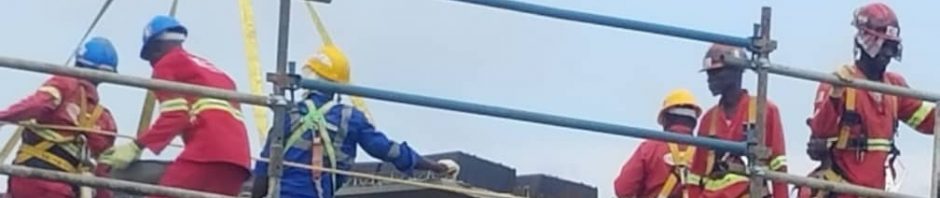
For most construction project management,the HSE office is always a functional department which works directly under the project manager for the successfully completion of the project. Certain jurisdictions have clear responsibilities of all parties of a construction project.For instance,the HSE regulations of Construction (Design and Management)2015 makes it a legal obligation on the designers of a project to ensure assessment of all significant risks,to eliminate and control all foreseeable health and safety risks.
In real terms during the construction phase,it is absolutely clear that the HSE department ensures enforcement on work practices and conformation to the site safety rules in order to achieve this feat. Ironically, the principal designer is not visible in terms of health and safety on the construction phase as many designers conclude their tasks even before the start of the construction phase as per contract terms. The task of the HSE office is therefore relevant in this case especially as the designer may not be available and it’s duties automatically relinquished to the client. One of the challenging decisions of the project manager is dealing with determination of which health and safety risks controls with bearings on cost and time delays on the project are proportionate and reasonable to allow.It is normally a case of disagreement between the HSE office and the Production office. The cue to an ideal project decision is definitely an understanding of the cost benefit analysis of these actions and it’s overall impact on the successful completion of the project.
The Independence of the judgement of the HSE office is thus very important in ensuring that it is firm to enact corrective actions and prohibition notes on certain activities or work procedures that may inadvertently cause a major injury or risk of fatality on the project. Certainly,where there are no specific laws on procedures for undertaking key high risk activities,it definitely becomes a difficult task for the HSE office.Being a health and safety officer on a project where you’re also an employee can indeed be challenging. Balancing firmness with professionalism while maintaining independence involves a few key strategies which I have analysed and summarized as below. These points I have noted are based on my personal experiences having worked in similar roles and also working in HSE consulting auditing some projects in Ghana.
Firstly,when you are employed in an organisation,it is important to clearly define and communicate your role and responsibilities. Make sure that both management and employees understand that your role is to ensure safety and compliance, not to serve as a disciplinary figure.Your renumeration are as a result of your absolute fair judgement and performance of your duties. You are not employed to “close your eyes” to non conformance and get paid at the end of the month. Whether you will be consulted, respected and seen as diligent in your work will be dependent on you performing your duties firmly and providing appropriate judgement to the level of significant risks that you able to identify.
Always base your decisions and recommendations on facts, regulations, and industry standards, rather than personal opinions.Before you make a decision to discuss any safety issue with management,it is important to assess critically the level of risks and examine all options of control and their consequences. Your decisions should not be based on your personal opinion when all other persons do not share your opinion of the level of risk. The suitable way to convince your management is finding appropriate basis of law, international standard or case study similar to the identified risk. This helps in maintaining objectivity and reducing potential conflicts of interest.
Do not compromise on safety at all where there is a foreseeable risk of injury. The ultimate decisions on projects are with the project manager. However,you should always make your diverse opinion and decision known to the project manager.If there is an eminent foreseeable risk of life or injury,it is very important to highlight the disapproval of the HSE office on such works to the project manager.If the project management decides to undertake the task without any controls to the risk where there is still a foreseeable risk to severe injury ,it is important to inform all workers about such risks as well. All workers have the right to avoid safe work and therefore would desist from such work knowing that the HSE office disapproves the work.It must be emphasized that workers rely much on the decision of what is safe work and unsafe work as determined by the HSE office.
Apply safety rules consistently across all levels of the organization. Enhance management to understand that every worker including management staff shall follow all site rules.When other employees are exempted on following rules which other workers may be met with disciplinary actions when the breach,it does not create a positive safety culture among workers. This helps in establishing credibility and demonstrates that safety policies are not optional but are important for everyone.
Ensure to communicate clearly and regularly with both management and staff. Keep everyone informed about safety procedures, updates, and the rationale behind certain policies. Transparency helps in fostering trust and respect.Ensure you have the backing of senior management on health and safety issues.Their support can empower you to enforce policies more effectively and make it clear that safety is a top priority for the organization.The best way to achieve management support is by training. When management members are trained on health and safety,they also become champions of health and safety issues.
Regularly provide training and educational sessions on health and safety. This not only helps in keeping everyone informed but also reinforces the importance of safety in the workplace.
Implement a system for receiving and addressing safety concerns or suggestions from employees. This demonstrates that you value their input and are committed to continuous improvement.
I will advise you to also subscribe to a professional health and safety membership to stay updated on the latest safety regulations, best practices, and industry trends. This enhances your expertise and helps you remain confident and authoritative in your role.You can also learn from other industry experience on solving similar health and safety issues you might face.
Keep detailed records of safety inspections, incidents, and communications. This documentation will help management relies the importance of maintaining a no accident information on the project. Discuss regularly with management on the investigation recommendations of accidents that may occur on the site and actions for improvement.
Combining these approaches as a safety officer can help you to maintain your independence and enforce safety measures effectively while navigating the dynamics of being an employee within your firm.


 Grenotek Engineering Services