
The Government of Ghana has identified agricultural growth and transformation as a driver of jobs and industrialisation. Along with meeting needs in infrastructure, technology, water management, and the business environment, success will hinge on the availability of vocational and entrepreneurship training for young people.
The Ministry of Trade and Industry (MoTI) and the Ministry of Food and Agriculture (MFA) are helping prepare the agro-businessmen and businesswomen of the future by providing them today with opportunities to acquire the right training and experience in agro-processing, machinery, and business management. The International Fund for Agriculture Development (IFAD) and the African Development Bank are among the partners in this endeavour.
To draw attention to the importance of skills and entrepreneurship development as a success factor in agricultural development, UN Resident Coordinator to Ghana, Ms. Christine Evans-Klock, invited former UN Secretary-General Kofi Annan and Mrs. Nane Annan, and EU Ambassador to Ghana, Mr. William Hanna, to visit one of MoTI’s Rural Technology Facilities (RTF) and Business Advisory Centres (BAC) in Mankessim, in the Central Region. The visit was arranged by Esther Kasalu-Coffin, Country Director for IFAD, and her team. 
Through the RTFs and BACs, MoTI offers apprenticeships and training for master crafts persons in agribusiness and appropriate technology for micro and small-scale enterprises. The Mankessim facility builds low-cost machines that help farmers improve their productivity, for example fufu-pounding machines, and teaches welding, machining, and production skills to students in the process.
Students, graduates, trainers, and local officials explained how this training is transforming subsistence farming into productive agro-businesses – producing and marketing soaps, honey, leather goods, and food stuffs.
For the Mankessim site visit, former students displayed their products and talked about their business models and future plans. When asked what constrained their business growth, they spoke about difficulties acquiring start-up and operational capital, lack of skilled young people to hire, and specific gaps in the supply chain. One business’s difficulty acquiring packaging could well become a business opportunity for someone else, as value chains in agriculture expand. Ease of getting their products certified, meeting food safety requirements for example, is another important success factor in gaining consumers’ confidence and even entering export markets.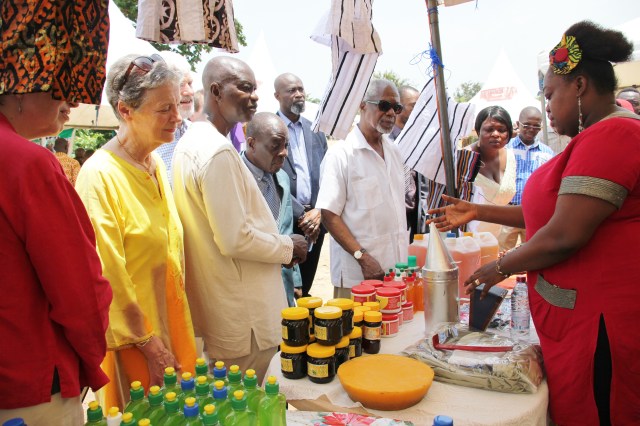
Mr. Annan expressed his appreciating for this kind of training that prepares young women and men for careers as agri-businessmen and agri-businesswomen, and called for scaling up such opportunities so that more young people, and their parents, can see technical and entrepreneurship training as a viable pathway to productive livelihoods. He pointed out that “instead of joining the ranks of unemployed graduates, these young people are creating and growing businesses.”
William Hanna, EU Ambassador to Ghana, complimented the Ministry of Trade and Industry for their commitment to skills and entrepreneurship training in the agriculture sector. Referring to support by the EU and the German government elsewhere in Ghana for vocational training, he said: “This is the kind of partnership that should continue, helping Ghana help itself through training its young people.”
Mfantseman Municipal Coordinating Director, Mr. Joseph Nyankumawu, shared the ambition to invest in youth as the way forward through the Rural Enterprises Programme’s “Enable Youth Programme”, targeting youth employment in the agribusiness sector that ultimately benefits the community.
21 RTFs have been established and 15 additional ones will be set up across Ghana as part of the Rural Enterprise Programme (REP). Supported by IFAD and the African Development Bank, the REP is part of the Government of Ghana’s efforts to reduce poverty, create wealth and improve living conditions in the rural areas. The National Programme Coordinator for REP, Mr. Kwasi Attah-Antwi, explained how the REP is improving livelihoods and incomes of rural poor micro and small entrepreneurs.
The visit followed Ghana’s celebration of International Women’s Day, on 8 March, under the theme “Women in the Changing World of Work: Planet 50:50 by 2030”. Ghana’s Ministry of Gender, Children and Social Protection led Ghana’s celebration by calling for the “economic empowerment of rural women.”
Gender parity is a cornerstone of the 2030 Agenda for Sustainable Development. Sustainable Development Goal 5 specifically calls for gender equality and women’s empowerment, but it is central to the achievement of all 17 Goals for economic, social and environmental development, for achieving food security and promoting sustainable agriculture, and for leaving no one behind.
“To accelerate Ghana’s agricultural transformation we need to first recognise the hard work and the economic contributions of women in the agriculture sector. We need to support their efforts to transform their farms, learn new skills, and grow their businesses,” said Ms. Christine Evans-Klock.
Original article from http://gh.one.un.org/content/unct/ghana/en/home/media-centre/news-and-press-releases/turning-farming-into-business-through-agricultural-skills-and-entrepreneurship-development.html


 Grenotek Engineering Services